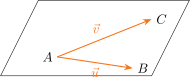
Définition.
Soit $\vec{u}$ et $\vec{v}$ deux vecteurs de l'espace et $A$, $B$ et $C$ trois points de l'espace tels que : $\vec{u} = \vec{AB}$ et $\vec{v} = \vec{AC}$.
Si $\vec{u}$ et $\vec{v}$ sont non nuls, le produit scalaire des deux vecteurs $\vec{u}$ et $\vec{v}$ dans l'espace est le produit scalaire des deux vecteurs $\vec{AB}$ et $\vec{AC}$ dans le plan $(ABC)$ si $A$, $B$ et $C$ ne sont pas alignés, ou dans tout plan comprenant $A$, $B$ et $C$ ; on le note $\vec{u}.\vec{v}$.
Si $\vec{u} = \vec{0}$ ou $\vec{v} = \vec{0}$, on convient que : $\vec{u}.\vec{v} = 0$.
Remarque
Remarques.
Soit $H$ le projeté orthogonal du point $C$ sur la droite $(AB)$.
Si $\vec{AB}$ et $\vec{AH}$ ont le même sens, alors $\vec{AB}.\vec{AC} = AB \times AH$.
Cela correspond au cas où l'angle géométrique $\widehat{BAC}$ est aigu.
Si $\vec{AB}$ et $\vec{AH}$ ont des sens contraires, alors $\vec{AB}.\vec{AC} = – AB \times AH$.
Cela correspond au cas où l'angle géométrique $\widehat{BAC}$ est obtus.
Toutes les propriétés du produit scalaire dans le plan restent valables dans l'espace.
Exemple
Exemples.
1) Soit $ABCDEFGH$ un cube dont l'arête a pour longueur $a$.
[Figure: Un cube $ABCDEFGH$ montrant les vecteurs $\vec{AF}$ et $\vec{GC}$]
Calculons le produit scalaire $\vec{AF}.\vec{GC}$ :
Puisque les faces d'un cube sont des carrés, alors : $\vec{GC} = \vec{EA}$.
De plus, $E$ est le projeté orthogonal de $F$ sur $(AE)$. Donc :
Calculons le produit scalaire $\vec{AF}.\vec{CD}$ :
Puisque $ABCD$ est un carré, alors : $\vec{CD} = \vec{BA}$. De plus, $B$ est le projeté orthogonal de $F$ sur $(AB)$.
Donc :
\[\vec{AF}.\vec{CD} = \vec{AF}.\vec{BA} = – AB \times BA = -a^2\]
2) Soit $SABCD$ une pyramide à base carrée de sommet $S$ dont toutes les arêtes ont la même longueur $a$.
[Figure: Une pyramide $SABCD$ à base carrée de sommet $S$ avec les diagonales de sa base.]
Calculons, en fonction de $a$, les produits scalaires suivants :
a) $\vec{SA}.\vec{SB}$ b) $\vec{SA}.\vec{SC}$ c) $\vec{SA}.\vec{AC}$ d) $\vec{SC}.\vec{AB}$
a) Pour calculer $\vec{SA}.\vec{SB}$, on se place dans le plan $(SAB)$.
Dans ce plan, les points $S$, $A$ et $B$ sont les sommets d'un triangle équilatéral. D'où :
\[\vec{SA}.\vec{SB} = SA \times SB \times \cos\frac{\pi}{3} = \frac{1}{2}a^2\]
b) Pour calculer $\vec{SA}.\vec{SC}$, on se place dans le plan $(SAC)$.
Les dimensions du triangle $SAC$ sont connues :
$SA = SC = a$ et $AC = \sqrt{2}a$ (car $[AC]$ est la diagonale du carré $ABCD$). Le triangle $SAC$ est donc rectangle en $S$.
Par suite : $\vec{SA}.\vec{SC} = 0$.
c) Dans le plan $(SAC)$, le projeté orthogonal du point $S$ sur la droite $(AC)$ est le milieu $O$ de $[AC]$.
D'où :
\[\vec{SA}.\vec{AC} = \vec{OA}.\vec{AC} = – OA \times AC = – \frac{a\sqrt{2}}{2} \times \sqrt{2}a = -a^2\]
d) On a : $\vec{AB} = \vec{DC}$, on se place donc dans le plan $(SDC)$. Il en résulte donc :
Applications.
1. Soit $ABCDEFGH$ un parallélépipède rectangle tel que :
\[AE = 5 \text{et} AB = 8 \text{et} AD = 6\]
Calculer les produits scalaires suivants : $\vec{AE}.\vec{BG}$ ; $\vec{AC}.\vec{HF}$ ; $\vec{AE}.\vec{DG}$
2. Soit $ABCEFG$ un prisme droit tel que le triangle $ABC$ est rectangle en $A$.
[Figure: Un prisme droit $ABCEFG$ à base triangulaire rectangle en $A$.]
On suppose que : $AC = 3 \text{et} AB = 4 \text{et} AE = 8$.
Calculer les produits scalaires suivants : $\vec{AE}.\vec{AF}$ ; $\vec{CG}.\vec{AF}$ ; $\vec{BC}.\vec{EG}$
2.ORTHOGONALITÉ DE DEUX VECTEURS
Définition
Définition.
Deux vecteurs $\vec{u}$ et $\vec{v}$ de l'espace sont orthogonaux si $\vec{u}.\vec{v} = 0$. On écrit : $\vec{u} \perp \vec{v}$
Exemple
Exemple.
Dans le cube $ABCDEFGH$ :
Les vecteurs $\vec{DH}$ et $\vec{DC}$ sont orthogonaux, c'est-à-dire que : $\vec{DH}.\vec{DC} = 0$.
On a : $\vec{EH}.\vec{GC} = \vec{EH}.\vec{HD} = 0$ (car $\vec{EH} \perp \vec{HD}$). Par conséquent : $\vec{EH} \perp \vec{GC}$
La droite $(AE)$ est perpendiculaire au plan $(ABC)$, donc elle est perpendiculaire à toutes les droites incluses dans ce plan. Comme $(DB) \subset (ABC)$ alors $(AE) \perp (DB)$. Ainsi : $\vec{AE}.\vec{BD} = 0$.
3.SYMÉTRIE ET BILINÉARITÉ DU PRODUIT SCALAIRE
Proposition
Proposition.
Soit $\vec{u}$, $\vec{v}$ et $\vec{w}$ trois vecteurs de l'espace $\mathcal{V}_3$ et $k$ un nombre réel. On a les propriétés suivantes :
1) $\vec{u}.\vec{v} = \vec{v}.\vec{u}$ ; 2) $(k\vec{u}).\vec{v} = \vec{u}.(k\vec{v}) = k(\vec{u}.\vec{v})$ ; 3) $\vec{u}.(\vec{v} + \vec{w}) = \vec{u}.\vec{v} + \vec{u}.\vec{w}$
On dit que le produit scalaire est une opération symétrique et bilinéaire.
Application
Applications.
Soit $ABCD$ un tétraèdre régulier dont toutes les arêtes ont la même longueur $a$.
[Figure: Un tétraèdre régulier $ABCD$ avec $J$ milieu de $[BC]$ et $K$ milieu de $[AD]$.]
Soit $J$ et $K$ les milieux respectifs des segments $[BC]$ et $[AD]$.
1. Calculer $\vec{CB}.\vec{CA}$ et $\vec{CB}.\vec{CD}$ puis en déduire $\vec{CB}.\vec{AD}$.
2. Calculer $\vec{AC}.\vec{AD}$ et en déduire $\vec{AJ}.\vec{CK}$ en fonction de $a$.
4.NORME D’UN VECTEUR DE L’ESPACE
Définition
Définition.
Soit $\vec{u}$ un vecteur de l'espace.
Le produit scalaire $\vec{u}.\vec{u}$ s'appelle le carré scalaire du vecteur $\vec{u}$ et se note $\vec{u}^2$.
Le nombre réel positif $\sqrt{\vec{u}^2}$ est appelé la norme du vecteur $\vec{u}$ et on écrit : $\|\vec{u}\| = \sqrt{\vec{u}^2}$
Remarque
Remarque.
En posant $\vec{u} = \vec{AB}$, on a : $\vec{u}^2 = \vec{AB}^2 = AB^2 = \|\vec{AB}\|^2$
Proposition
Proposition.
Soit $\vec{u}$ et $\vec{v}$ deux vecteurs de l'espace $\mathcal{V}_3$ et $k$ un nombre réel. On a :
1) $\|\vec{u}\| = 0 \Leftrightarrow \vec{u} = \vec{0}$ ; 2) $\|k\vec{u}\| = |k|\|\vec{u}\|$ ; 3) $\vec{u}.\vec{v} = \|\vec{u}\|.\|\vec{v}\|.\cos(\widehat{\vec{u};\vec{v}})$
4) Inégalité triangulaire : $\|\vec{u} + \vec{v}\| \le \|\vec{u}\| + \|\vec{v}\|$.
5) Inégalité de Cauchy-Schwarz : $|\vec{u}.\vec{v}| \le \|\vec{u}\|.\|\vec{v}\|$.
6) Identités remarquables :
Exemples.
1) Soit $A$, $B$ et $C$ trois points de l'espace tels que : $AB = 5$ et $\vec{AB}.\vec{AC} = 3$
Calculons le produit scalaire : $(-2\vec{AB}).\vec{BC}$.
On a :
Preuve.
On a : $\vec{u} = x\vec{i} + y\vec{j} + z\vec{k}$ et $\vec{v} = x'\vec{i} + y'\vec{j} + z'\vec{k}$. En tenant compte du fait que $(\vec{i}; \vec{j}; \vec{k})$ est une base orthonormée, il en résulte de la définition précédente et de la bilinéarité du produit scalaire :
D'où le résultat.
En prenant $\vec{u} = \vec{v}$, on obtient : $\|\vec{u}\|^2 = x^2 + y^2 + z^2$, ce qui donne : $\|\vec{u}\| = \sqrt{x^2 + y^2 + z^2}$.
Exemple
Exemple.
On considère les vecteurs : $\vec{u} = 2\vec{i} + 2\vec{j} – \vec{k}$ ; $\vec{v} = \vec{i} – \vec{j} + 3\vec{k}$ ; $\vec{w} = (2m-3)\vec{i} + \vec{j} + m\vec{k} (m \in \mathbb{R})$
Calculons : $\vec{u}.\vec{v} ; \vec{u}.\vec{w} ; \|\vec{u}\| ; \|\vec{v}\|$.
On a : $\vec{u}.\vec{v} = 2 \times 1 + 2 \times (-1) + (-1) \times 3$, ce qui donne : $\vec{u}.\vec{v} = -3$.
On a : $\vec{u}.\vec{w} = 2 \times (2m-3) + 2 \times 1 + (-1) \times m$, ce qui donne : $\vec{u}.\vec{w} = 3m-4$.
On a : $\|\vec{u}\| = \sqrt{2^2 + 2^2 + (-1)^2} = \sqrt{9} = 3$ et $\|\vec{v}\| = \sqrt{1^2 + (-1)^2 + 3^2} = \sqrt{11}$.
Déterminons la valeur de $m$ pour laquelle $\vec{u}$ et $\vec{w}$ sont orthogonaux :
Applications.
1. On considère les vecteurs : $\vec{u} = 2\vec{i} + 3\vec{j} + \vec{k}$ ; $\vec{v} = \vec{i} – 2\vec{j} + 3\vec{k}$ ; $\vec{w} = (4-3m)\vec{i} + 5\vec{j} + (1+m)\vec{k} (m \in \mathbb{R})$.
a) Calculer : $\vec{u}.\vec{v} ; \vec{u}.\vec{w} ; \vec{v}.\vec{w} ; \|\vec{u}\| ; \|\vec{v}\|$.
b) Déterminer la valeur de réel $m$ pour laquelle $\vec{u}$ et $\vec{w}$ sont orthogonaux.
c) Calculer $\cos(\widehat{\vec{u};\vec{v}})$.
2. Soit $ABCDEFGH$ un parallélépipède rectangle tel que : $AB = AE = 2$ et $AD = 4$.
Soit $I$ le centre du carré $ABFE$ et $J$ le milieu du segment $[EH]$.
a) Vérifier que le repère $(A; \frac{1}{2}\vec{AB}; \frac{1}{4}\vec{AD}; \frac{1}{2}\vec{AE})$ est orthonormé.
b) Déterminer, dans ce repère, les coordonnées des points : $I$ ; $J$ ; $G$.
c) Calculer le produit scalaire $\vec{JI}.\vec{JG}$ et les distances $JI$ et $JG$.
2.3. DÉTERMINATION ANALYTIQUE DE L’ENSEMBLE DES POINTS $M$ DE L’ESPACE TELS QUE $\vec{u}.\vec{AM} = k$
Proposition
Proposition.
Soit $\vec{u}(a; b; c)$ un vecteur non nul de l'espace $\mathcal{V}_3$, $A$ un point et $k$ un nombre réel.
L'ensemble des points $M$ de l'espace $\mathcal{E}$ tels que $\vec{u}.\vec{AM} = k$ est un plan dont une équation cartésienne est de la forme :
\[ax + by + cz + d = 0\]
Preuve
Preuve.
On considère un point $A(x_A; y_A; z_A)$, un vecteur $\vec{u}(a; b; c)$ non nul et un réel $k$.
On considère l'ensemble : $\mathcal{P} = \{ M(x; y; z) \in \mathcal{E} / \vec{u}.\vec{AM} = k \}$
On a :
\[M(x; y; z) \in \mathcal{P} \Leftrightarrow ax + by + cz + d = 0 \text{où } d = -(ax_A + by_A + cz_A + k)\]
Puisque les réels $a, b$ et $c$ ne sont pas tous nuls, alors $\mathcal{P}$ est un plan d'équation : $ax + by + cz + d = 0$.
Exemple
Exemple.
On considère le point $A(-1; 3; 2)$ et le vecteur $\vec{u}(2; 1; -3)$.
Déterminons l'ensemble $\mathcal{P}$ des points $M$ de l'espace $\mathcal{E}$ tels que : $\vec{u}.\vec{AM} = 7$.
Soit $M(x; y; z)$ un point de l'espace. On a :
Par conséquent, l'ensemble $\mathcal{P}$ est le plan d'équation :
\[2x + y – 3z – 2 = 0\]
III.PLAN DÉFINI PAR UN POINT ET UN VECTEUR NORMAL
3.1. VECTEUR NORMAL À UN PLAN
Définition
Définition.
Un vecteur $\vec{n}$ non nul de l'espace est normal à un plan $\mathcal{P}$ lorsque toute droite de vecteur directeur $\vec{n}$ est perpendiculaire à $\mathcal{P}$.
Exemple
Exemple.
Soit $ABCDEFGH$ un cube.
Démontrons que $\vec{AG}$ est un vecteur normal au plan $(BDE)$ :
Le vecteur $\vec{AG}$ est orthogonal à $\vec{EB}$. En effet, $\vec{AG}.\vec{EB} = 0$ car :
Or $\vec{AH}.\vec{ED} = 0$ et $\vec{HG}.\vec{ED} = \vec{HG}.(\vec{EH} + \vec{HD}) = \vec{HG}.\vec{EH} + \vec{HG}.\vec{HD} = 0$.
Les vecteurs $\vec{EB}$ et $\vec{ED}$ ne sont pas colinéaires ; $\vec{AG}$ est un vecteur normal au plan $(BDE)$.
[Figure: Un cube $ABCDEFGH$ avec les segments $AG$, $EB$ et $ED$ tracés.]
3.2. ÉQUATION CARTÉSIENNE D’UN PLAN DÉFINI PAR UN POINT ET UN VECTEUR NORMAL
Proposition
Proposition.
Soit $a, b, c$ et $d$ des nombres réels tels que $(a;b;c) \neq (0;0;0)$.
Un plan de vecteur normal $\vec{n}(a; b; c)$ a une équation cartésienne de la forme :
\[ax + by + cz + d = 0\]
Réciproquement, l'ensemble des points $M(x; y; z)$ de l'espace tels que $ax + by + cz + d = 0$ est un plan dont un vecteur normal est $\vec{n}(a; b; c)$.
Preuve
Preuve.
Soit $\mathcal{P}$ le plan défini par le point $A(x_A; y_A; z_A)$ et de vecteur normal $\vec{n}(a; b; c)$.
On a :
où : $d = -(ax_A + by_A + cz_A)$.
Ainsi, une équation cartésienne du plan $\mathcal{P}$ est : $ax + by + cz + d = 0$.
Réciproquement, soit $\mathcal{Q}$ un plan d'équation cartésienne $ax + by + cz + d = 0$ avec $(a; b; c) \neq (0; 0; 0)$.
Soit $A(x_A; y_A; z_A)$ un point du plan $\mathcal{Q}$. Il s'ensuit donc :
D'où : $M(x; y; z) \in \mathcal{Q} \Leftrightarrow \vec{n}.\vec{AM} = 0$. Ainsi, $\vec{n}(a; b; c)$ est un vecteur normal au plan $\mathcal{Q}$.
[Figure: Un plan $\mathcal{P}$ défini par un point $A$ et un vecteur normal $\vec{n}$. Un point $M$ appartient au plan.]
Exemple
Exemple.
Déterminons une équation cartésienne du plan $\mathcal{P}$ passant par $A(-1; 2; 1)$ et de vecteur normal $\vec{n}(2; 1; -3)$.
\underline{1ère méthode :} Soit $M(x; y; z)$ un point de l'espace. On a :
Ainsi, une équation cartésienne du plan $\mathcal{P}$ est : $\mathcal{P} : 2x + y – 3z + 3 = 0$
\underline{2ème méthode :} Soit $M(x; y; z)$ un point de l'espace. Puisque $\vec{n}(2; 1; -3)$ est un vecteur normal au plan $\mathcal{P}$, alors une équation cartésienne de $\mathcal{P}$ s'écrit : $2x + y – 3z + d = 0$ avec $d \in \mathbb{R}$.
Et comme $A(-1; 2; 1) \in \mathcal{P}$, alors : $-2 + 2 – 3 + d = 0$, ce qui donne : $d = 3$.
Ainsi, une équation cartésienne du plan $\mathcal{P}$ est : $\mathcal{P} : 2x + y – 3z + 3 = 0$.
Application
Applications.
1. Déterminer un vecteur normal au plan $\mathcal{P}$ dans chacun des cas suivants :
a) $\mathcal{P} : 2x – y + 8z – 1 = 0 ; $ b) $\mathcal{P} : 3x – 2z + 10 = 0 ; $ c) $\mathcal{P} : 2y + 3 = 0$
2. Déterminer une équation cartésienne du plan $\mathcal{Q}$ passant par $B(-1; 0; 3)$ et de vecteur normal $\vec{n}(2; -3; 4)$.
3. On considère les points : $A(1; -1; 1)$ et $B(0; 2; -1)$ et $C(-1; 1; 0)$.
a) Vérifier que les points $A, B$ et $C$ ne sont pas alignés.
b) Montrer que le vecteur $\vec{n}(1; 3; 4)$ est normal au plan $(ABC)$.
3.3. PARALLÉLISME ET ORTHOGONALITÉ
Proposition
Proposition.
Soit $\mathcal{P}, \mathcal{P}'$ deux plans et $\mathcal{D}$ une droite dans l'espace.
Soit $\vec{n}, \vec{n}'$ deux vecteurs normaux respectivement à $\mathcal{P}, \mathcal{P}'$ et $\vec{u}$ un vecteur directeur de $\mathcal{D}$. Alors :
1) Les plans $\mathcal{P}$ et $\mathcal{P}'$ sont parallèles si, et seulement si, les vecteurs $\vec{n}$ et $\vec{n}'$ sont colinéaires.
2) Les plans $\mathcal{P}$ et $\mathcal{P}'$ sont orthogonaux si, et seulement si, les vecteurs $\vec{n}$ et $\vec{n}'$ sont orthogonaux.
3) La droite $\mathcal{D}$ est parallèle au plan $\mathcal{P}$ si, et seulement si, les vecteurs $\vec{n}$ et $\vec{u}$ sont orthogonaux.
4) La droite $\mathcal{D}$ est perpendiculaire au plan $\mathcal{P}$ si, et seulement si, les vecteurs $\vec{n}$ et $\vec{u}$ sont colinéaires.
Exemple
Exemples.
1) On considère les deux plans : $\mathcal{P} : 2x – 4y + z + 1 = 0$ et $\mathcal{P}' : x + y + 2z – 3 = 0$
On a : $\vec{n}(2; -4; 1)$ est un vecteur normal à $\mathcal{P}$ et $\vec{n}'(1; 1; 2)$ est un vecteur normal à $\mathcal{P}'$.
De plus : $\vec{n}.\vec{n}' = 2 – 4 + 2 = 0$. Par suite : $\mathcal{P} \perp \mathcal{P}'$.
2) Déterminons une équation du plan $\mathcal{Q}$ passant par $A(1; -1; 1)$ et parallèle au plan $\mathcal{Q}' : 3x + y – 5z = 0$
Puisque $\mathcal{Q} \parallel \mathcal{Q}'$ alors $\vec{n}(3; 1; -5)$ est un vecteur normal au plan $\mathcal{Q}$. Il s'ensuit donc qu'une équation cartésienne du plan $\mathcal{Q}$ s'écrit : $3x + y – 5z + d = 0$. Et puisque $A \in \mathcal{Q}$, alors : $3 – 1 – 5 + d = 0$, ce qui donne : $d = 3$. Ainsi, une équation cartésienne de $\mathcal{Q}$ est : $\mathcal{Q} : 3x + y – 5z + 3 = 0$.
3) On considère le point $A(1; 0; -2)$, le plan $\mathcal{P}$ d'équation $x – y + 3z = 0$ et les droites $\mathcal{D}_1$ et $\mathcal{D}_2$ définies par :
\[\mathcal{D}_1 : \begin{cases} x = 2t \\ y = 2 – 2t (t \in \mathbb{R}) \\ z = 6t \end{cases} \text{et} \mathcal{D}_2 : \begin{cases} x = -1 + k \\ y = -2k (k \in \mathbb{R}) \\ z = 3 – k \end{cases}\]
On a : $\vec{n}(1; -1; 3)$ est un vecteur normal au plan $\mathcal{P}$, $\vec{u}(2; -2; 6)$ est un vecteur directeur de la droite $\mathcal{D}_1$ et $\vec{v}(1; -2; -1)$ est un vecteur directeur de la droite $\mathcal{D}_2$.
Puisque $\vec{u} = 2\vec{n}$ alors les vecteurs $\vec{n}$ et $\vec{u}$ sont colinéaires et par suite : $\mathcal{D}_1 \perp \mathcal{P}$.
Comme : $\vec{n}.\vec{v} = 1 \times 1 + (-1) \times (-2) + 3 \times (-1) = 1 + 2 – 3 = 0$, alors $\vec{n} \perp \vec{v}$. Par suite : $\mathcal{D}_2 \parallel \mathcal{P}$.
Application
Applications.
On considère les deux plans $\mathcal{P}$ et $\mathcal{Q}$ définis par les équations cartésiennes : $(m \in \mathbb{R})$
1. Déterminer la valeur de $m$ pour laquelle les plans $\mathcal{P}$ et $\mathcal{Q}$ sont orthogonaux.
2. Déterminer une équation cartésienne du plan $\mathcal{P}'$ passant par $A(-1; -1; 0)$ et parallèle au plan $\mathcal{P}$.
3.4. DISTANCE D’UN POINT À UN PLAN DE L’ESPACE
Définition
Définition.
Soit $\mathcal{P}$ un plan et $A$ un point de l'espace.
La distance du point $A$ au plan $\mathcal{P}$, notée $d(A; \mathcal{P})$, est la distance $AH$ où $H$ est le projeté orthogonal de $A$ sur $\mathcal{P}$ : $d(A; \mathcal{P}) = AH$.
[Figure: Un plan $\mathcal{P}$ avec un point $A$ et son projeté orthogonal $H$ sur $\mathcal{P}$, la distance $d(A; \mathcal{P})$ est le segment $AH$.]
Proposition
Proposition.
La distance du point $A(x_A; y_A; z_A)$ au plan $\mathcal{P}$ d'équation cartésienne $ax + by + cz + d = 0$ est donnée par la formule suivante :
Preuve.
Soit $\mathcal{P}$ le plan d'équation $ax + by + cz + d = 0$ et $A(x_A; y_A; z_A)$ un point de l'espace. On sait que $\vec{n}(a; b; c)$ est un vecteur normal au plan $\mathcal{P}$. Soit $H(x; y; z)$ le projeté orthogonal du point $A$ sur le plan $\mathcal{P}$.
Il existe donc $k \in \mathbb{R}$ tel que $\vec{AH} = k.\vec{n}$, c'est-à-dire : $x = x_A + ka$ et $y = y_A + kb$ et $z = z_A + kc$.
Comme $H \in \mathcal{P}$, alors : $a(x_A + ka) + b(y_A + kb) + c(z_A + kc) + d = 0$
ce qui donne : $k(a^2 + b^2 + c^2) + (ax_A + by_A + cz_A + d) = 0$, c'est-à-dire : $k = -\frac{ax_A + by_A + cz_A + d}{a^2 + b^2 + c^2}$.
La distance du point $A$ au plan $\mathcal{P}$ est :
Exemples.
On considère le plan $\mathcal{P}$ d'équation : $2x – y + 2z + 3 = 0$ et les points $A(1; -1; 2)$ et $B(0; 2; -2)$.
Calculons $d(A; \mathcal{P})$ et $d(B; \mathcal{P})$ :
On a :
Applications.
1. On considère les plans : $\mathcal{P} : x + y – z + 1 = 0 \text{et} \mathcal{Q} : 2x + y + 2z – 3 = 0$
a) Calculer $d(A; \mathcal{P})$ et $d(A; \mathcal{Q})$ sachant que $A(2; 1; -1)$.
b) Déterminer l'ensemble des points $M$ de l'espace $\mathcal{E}$ tels que : $d(M; \mathcal{P}) = d(M; \mathcal{Q})$.
2. On considère les points $A(1; -1; 2)$ et $B(2; 0; 1)$ et les plans $\mathcal{P}$ et $\mathcal{Q}$ donnés par les équations :
\[\mathcal{P} : x + y – z – 1 = 0 \text{et} \mathcal{Q} : 2x + y – z + 1 = 0\]
a) Calculer la distance du point $A$ au plan $\mathcal{P}$.
b) Montrer que le point $H(2; 0; 1)$ est le projeté orthogonal du point $A$ sur le plan $\mathcal{P}$.
c) Calculer $d(A; \mathcal{Q})$. Que peut-on déduire ?
3. On considère dans l'espace $\mathcal{E}$ le point $A(-1; 1; 1)$ et plan $\mathcal{P}$ d'équation cartésienne : $2x – y + z – 2 = 0$.
a) Déterminer les coordonnées du point $H$ projeté orthogonal du point $A$ sur le plan $\mathcal{P}$.
b) Pour tout réel $m$, on pose : $\mathcal{Q}_m = \{ M \in \mathcal{E} / \vec{AM}.\vec{AH} = m \}$.
Déterminer analytiquement l'ensemble $\mathcal{Q}_m$.
c) Déterminer $m$ tel que : $d(A; \mathcal{Q}_m) = d(A; \mathcal{P})$.
IV.LA SPHÈRE DANS L’ESPACE
4.1. DÉFINITION
Définition
Définition.
Soit $\Omega$ un point de l'espace et $R$ un réel positif.
La sphère $\mathcal{S}$ de centre $\Omega$ et de rayon $R$ est l'ensemble des points $M$ de l'espace tels que : $\Omega M = R$. On la note $\mathcal{S}(\Omega; R)$.
Soit $A, B$ deux points de la sphère $\mathcal{S}$. Le segment $[AB]$ est appelé diamètre de la sphère $\mathcal{S}$ lorsque le centre $\Omega$ de la sphère $\mathcal{S}$ est le milieu du segment $[AB]$.
[Figure: Une sphère de centre $\Omega$ et de rayon $R$. Un point $M$ sur la sphère, et un diamètre $[AB]$.]
4.2. ÉQUATION CARTÉSIENNE D’UNE SPHÈRE
Proposition
Proposition.
Soit $R$ un réel positif et $\Omega(a; b; c)$ un point de l'espace.
Une équation cartésienne de la sphère $\mathcal{S}$ de centre $\Omega$ et de rayon $R$ est donnée par :
\[(x – a)^2 + (y – b)^2 + (z – c)^2 = R^2\]
Preuve
Preuve.
Soit $\mathcal{S}$ la sphère de centre $\Omega(a; b; c)$ et de rayon $R$. On a immédiatement :
Exemple.
Soit $\mathcal{S}$ la sphère de centre $\Omega(1; -1; 2)$ et de rayon $R = 3$.
Une équation cartésienne de $\mathcal{S}$ est donnée par : $M(x; y; z) \in \mathcal{S} \Leftrightarrow (x – 1)^2 + (y + 1)^2 + (z – 2)^2 = 3^2$.
Par suite : $\mathcal{S} : x^2 + y^2 + z^2 – 2x + 2y – 4z – 3 = 0$
Considérons les points : $A(-1; 1; 3)$ et $B(1; 1; -1)$
$\circ$ On a : $(x_A – 1)^2 + (y_A + 1)^2 + (z_A – 2)^2 = 4 + 4 + 1 = 9 = R^2$. Par conséquent : $A \in \mathcal{S}$.
$\circ$ On a : $(x_B – 1)^2 + (y_B + 1)^2 + (z_B – 2)^2 = 0 + 4 + 9 = 13 \neq R^2$. Par conséquent : $B \notin \mathcal{S}$.
Application
Applications.
Déterminer une équation cartésienne de la sphère $\mathcal{S}$ de centre $\Omega$ et de rayon $R$ dans les cas suivants :
\underline{1er cas :} $\Omega(2; 0; -1)$ et $R = \sqrt{2} ; $ \underline{2nd cas :} $\Omega(-3; 1; -2)$ et $R = \frac{3}{2}$
4.3. REPRÉSENTATION PARAMÉTRIQUE D’UNE SPHÈRE
Proposition
Proposition.
Soit $\mathcal{S}$ la sphère de centre $\Omega(a; b; c)$ et de rayon $R$. Le point $M(x; y; z)$ appartient à la sphère $\mathcal{S}$ si, et seulement si :
\[\begin{cases} x = a + R\sin\varphi.\cos\theta \\ y = b + R\sin\varphi.\sin\theta \\ z = c + R\cos\varphi \end{cases} / (\varphi; \theta) \in \mathbb{R}^2\]
Ce système est appelé une représentation paramétrique de la sphère $\mathcal{S}$.
Exemple
Exemples.
1) Une représentation paramétrique de la sphère $\mathcal{S}$ de centre $\Omega(-1; 0; 2)$ et de rayon $R = 3$ est :
\[\begin{cases} x = -1 + 3\sin\varphi.\cos\theta \\ y = 3\sin\varphi.\sin\theta \\ z = 2 + 3\cos\varphi \end{cases} / (\varphi; \theta) \in \mathbb{R}^2\]
2) Soit $\mathcal{S}$ l'ensemble des points $M(x; y; z)$ de l'espace $\mathcal{E}$ tels que :
\[(*) \begin{cases} x = \frac{1}{2} + 2\sin\varphi.\cos\theta \\ y = -1 + 2\sin\varphi.\sin\theta \\ z = 1 + 2\cos\varphi \end{cases} / (\varphi; \theta) \in \mathbb{R}^2\]
Déterminons la nature de l'ensemble $\mathcal{S}$ :
Soit $M(x; y; z)$ un point de $\mathcal{S}$. On a :
Par conséquent, l'ensemble $\mathcal{S}$ est inclus dans la sphère $\mathcal{S}'$ de centre $\Omega\left(\frac{1}{2}; -1; 1\right)$ et de rayon $R = 2$.
Le système $(*)$ est une représentation paramétrique de la sphère $\mathcal{S}'$. Il s'ensuit donc que $\mathcal{S} = \mathcal{S}'$, c'est-à-dire, la sphère $\mathcal{S}'$ de centre $\Omega\left(\frac{1}{2}; -1; 1\right)$ et de rayon $R = 2$.
Application
Applications.
Déterminer une représentation paramétrique de la sphère $\mathcal{S}$ de centre $\Omega\left(\frac{3}{2}; -1; \frac{1}{2}\right)$ et de rayon $R = \sqrt{3}$.
4.4. ENSEMBLE DES POINTS $M(x; y; z)$ DE L’ESPACE TELS QUE : $x^2 + y^2 + z^2 – 2ax – 2by – 2cz + d = 0$
Proposition
Proposition.
Soit $\mathcal{S}$ l'ensemble des points $M(x; y; z)$ de l'espace tels que : $x^2 + y^2 + z^2 – 2ax – 2by – 2cz + d = 0$
où $a, b, c$ et $d$ des nombres réels.
1) Si $a^2 + b^2 + c^2 – d > 0$, alors $\mathcal{S}$ est la sphère de centre $\Omega(a; b; c)$
et de rayon $R = \sqrt{a^2 + b^2 + c^2 – d}$.
2) Si $a^2 + b^2 + c^2 – d = 0$, alors : $\mathcal{S} = \{\Omega(a; b; c)\}$.
3) Si $a^2 + b^2 + c^2 – d < 0$, alors : $\mathcal{S} = \emptyset$.
Preuve
Preuve.
Soit $M(x; y; z)$ un point de l'espace $\mathcal{E}$. On a donc :
L'égalité $(*)$ nous amène à la discussion suivante :
Si $a^2 + b^2 + c^2 – d > 0$ alors l'égalité $(*)$ devient : $\Omega M = \sqrt{a^2 + b^2 + c^2 – d}$. Dans ce cas, $\mathcal{S}$ est la sphère de centre $\Omega(a; b; c)$ et de rayon $R = \sqrt{a^2 + b^2 + c^2 – d}$.
Si $a^2 + b^2 + c^2 – d = 0$, alors l'égalité $(*)$ devient : $\Omega M = 0$, c'est-à-dire $M = \Omega$. Ainsi : $\mathcal{S} = \{\Omega\}$.
Si $a^2 + b^2 + c^2 – d < 0$ alors l'égalité $(*)$ est fausse. Par conséquent : $\mathcal{S} = \emptyset$.
Exemple
Exemples.
1) Soit $\mathcal{S}_1$ l'ensemble des points $M(x; y; z)$ de l'espace $\mathcal{E}$ tels : $x^2 + y^2 + z^2 – 2x – 6y – 4z = 0$
Ici : $a = 1 ; b = 3 ; c = 2 ; d = 0 ; a^2 + b^2 + c^2 – d = 1 + 9 + 4 = 14$.
Comme $a^2 + b^2 + c^2 – d > 0$, alors $\mathcal{S}_1$ est la sphère de centre $\Omega_1(1; 3; 2)$ et de rayon : $R_1 = \sqrt{14}$.
2) Soit $\mathcal{S}_2$ l'ensemble des points $M(x; y; z)$ de l'espace $\mathcal{E}$ tels : $x^2 + y^2 + z^2 – 6x + 4y + 6z + 22 = 0$
Déterminons la nature de l'ensemble $\mathcal{S}_2$ :
On a :
4.5. ENSEMBLE DES POINTS $M$ DE L’ESPACE TELS QUE $\vec{MA}.\vec{MB} = 0$
Proposition
Proposition.
Soit $A$ et $B$ deux points distincts de l'espace $\mathcal{E}$.
1) L'ensemble $\mathcal{S}$ des points $M$ de l'espace tels que $\vec{AM}.\vec{BM} = 0$ est la sphère de diamètre $[AB]$.
2) Une équation cartésienne de la sphère $\mathcal{S}$ est donnée par :
Exemple.
On considère dans l'espace $\mathcal{E}$ les deux points : $A(-1; 2; 1)$ et $B(1; -1; 0)$
L'ensemble $\mathcal{S}$ des points $M(x; y; z)$ de l'espace $\mathcal{E}$ tels que $\vec{MA}.\vec{MB} = 0$ est la sphère de diamètre $[AB]$.
Une équation cartésienne de la sphère $\mathcal{S}$ est donnée par :
\[\Leftrightarrow x^2 – 1 + y^2 – y – 2 + z^2 – z = 0\]
\[\Leftrightarrow x^2 + y^2 + z^2 – y – z – 3 = 0\]
Par suite : $\mathcal{S} : x^2 + y^2 + z^2 – y – z – 3 = 0$
Application
Applications.
On considère dans l'espace $\mathcal{E}$ les points suivants : $A(2; 0; 1) ; B(1; -1; 1) ; C(0; 0; -1)$
1. a) Déterminer une équation cartésienne de la sphère $\mathcal{S}$ de diamètre $[AB]$.
b) Calculer le produit scalaire $\vec{CA}.\vec{CB}$. Que peut-on déduire ?
2. a) Déterminer une équation cartésienne de la sphère $\mathcal{S}'$ de diamètre $[AC]$.
b) En déduire le centre et le rayon de la sphère $\mathcal{S}'$.
4.6. INTERSECTION D’UNE SPHÈRE ET D’UNE DROITE
Proposition
Proposition.
Soit $\mathcal{S}(\Omega; R)$ une sphère et $\mathcal{D}$ une droite de l'espace $\mathcal{E}$.
On désigne par $d$ la distance du point $\Omega$ à la droite $\mathcal{D}$ et $H$ le projeté orthogonal de $\Omega$ sur $\mathcal{D}$.
On a les propriétés suivantes :
1) Si $d > R$ alors $\mathcal{D} \cap \mathcal{S} = \emptyset$. On dit que la droite $\mathcal{D}$ est à l'extérieur de la sphère $\mathcal{S}$.
2) Si $d = R$ alors $\mathcal{D} \cap \mathcal{S} = \{H\}$. On dit que $\mathcal{D}$ est tangente à la sphère $\mathcal{S}$ au point $H$.
3) Si $d < R$ alors $\mathcal{D} \cap \mathcal{S} = \{A; B\}$. On dit que $\mathcal{D}$ perce la sphère $\mathcal{S}$ aux points $A$ et $B$.
4.7. INTERSECTION D’UNE SPHÈRE ET D’UN PLAN
Proposition
Proposition.
Soit $\mathcal{S}(\Omega; R)$ une sphère et $\mathcal{P}$ un plan de l'espace $\mathcal{E}$.
On désigne par $d$ la distance du point $\Omega$ au plan $\mathcal{P}$ et $H$ le projeté orthogonal de $\Omega$ sur $\mathcal{P}$.
On a les propriétés suivantes :
1) Si $d > R$ alors $\mathcal{P} \cap \mathcal{S} = \emptyset$. On dit que le plan $\mathcal{P}$ est à l'extérieur de la sphère $\mathcal{S}$.
2) Si $d = R$ alors $\mathcal{P} \cap \mathcal{S} = \{H\}$. On dit que $\mathcal{P}$ est tangent à la sphère $\mathcal{S}$ au point $H$.
3) Si $d < R$ alors $\mathcal{P} \cap \mathcal{S} = \mathcal{C}$ où $\mathcal{C}$ est le cercle de centre $H$ et de rayon $r = \sqrt{R^2 – d^2}$.
On dit que le plan $\mathcal{P}$ coupe la sphère $\mathcal{S}$ selon le cercle $\mathcal{C}\left(H; \sqrt{R^2 – d^2}\right)$.
Exemple
Exemples.
1) Soit $\mathcal{S}$ une sphère et $\mathcal{P}$ un plan de l'espace tels que :
Étudions l'intersection de la sphère $\mathcal{S}$ avec le plan $\mathcal{P}$ :
On a : $x^2 + y^2 + z^2 – 2x – 2y – 4 = 0 \Leftrightarrow (x – 1)^2 + (y – 1)^2 + z^2 = \left(\sqrt{6}\right)^2$
Donc $\mathcal{S}$ est la sphère de centre $\Omega(1; 1; 0)$ et de rayon $R = \sqrt{6}$.
On a de plus : $d(\Omega; \mathcal{P}) = \frac{|2 – 1 + 5|}{\sqrt{4 + 1 + 1}} = \frac{6}{\sqrt{6}} = \sqrt{6}$.
Comme $d(\Omega; \mathcal{P}) = R$, alors le plan $\mathcal{P}$ est tangent à la sphère $\mathcal{S}$ au point $H$ projeté orthogonal de $\Omega$ sur $\mathcal{P}$.
Déterminons les coordonnées du point $H$ :
Soit $\vec{n}(2; -1; -1)$ un vecteur normal au plan $\mathcal{P}$. Il existe $k \in \mathbb{R}$ tel que $\vec{\Omega H} = k.\vec{n}$. Il s'ensuit donc :
\[\begin{cases} \vec{\Omega H} = k.\vec{n} \\ H \in \mathcal{P} \end{cases} \Leftrightarrow \begin{cases} x = 1 + 2k \\ y = 1 – k \\ z = -k \\ 2x – y – z + 5 = 0 \end{cases} \Leftrightarrow \begin{cases} x = 1 + 2k \\ y = 1 – k \\ z = -k \\ 2(1 + 2k) – (1 – k) – (-k) + 5 = 0 \end{cases} \Leftrightarrow \begin{cases} x = -1 \\ y = 2 \\ z = 1 \\ k = -1 \end{cases}\]
Par suite : $H(-1; 2; 1)$.
2) Soit $\mathcal{S}$ une sphère et $\mathcal{P}$ un plan de l'espace tels que :
\[\mathcal{S} : x^2 + y^2 + z^2 – 2x + 2z + 1 = 0 \text{et} \mathcal{P} : x – y – z – 3 = 0\]
Étudions l'intersection de la sphère $\mathcal{S}$ avec le plan $\mathcal{P}$ :
On a : $x^2 + y^2 + z^2 – 2x + 2z + 1 = 0 \Leftrightarrow (x – 1)^2 + y^2 + (z + 1)^2 = 1$
Donc $\mathcal{S}$ est la sphère de centre $\Omega(1; 0; -1)$ et de rayon $R = 1$.
On a de plus : $d(\Omega; \mathcal{P}) = \frac{|1 – 0 – 1 – 3|}{\sqrt{1 + 1 + 1}} = \sqrt{3}$.
Comme $d(\Omega; \mathcal{P}) > R$ alors le plan $\mathcal{P}$ est à l'extérieur de la sphère $\mathcal{S}$. Ainsi : $\mathcal{S} \cap \mathcal{P} = \emptyset$.
3) Soit $\mathcal{S}$ la sphère et $\mathcal{P}$ le plan de l'espace tels que :
Étudions l'intersection de la sphère $\mathcal{S}$ et du plan $\mathcal{P}$ :
Clairement, $\mathcal{S}$ est la sphère de centre $\Omega(2; 1; -3)$ et de rayon $R = 3$.
On a de plus : $d(\Omega; \mathcal{P}) = \frac{|4 – 1 – 9 – 2|}{\sqrt{4 + 1 + 9}} = \frac{8}{\sqrt{14}} = \frac{4\sqrt{14}}{7}$.
Comme $d(\Omega; \mathcal{P}) < R$, alors le plan $\mathcal{P}$ coupe la sphère $\mathcal{S}$ suivant le cercle $\mathcal{C}$ de centre $H$ projeté orthogonal de $\Omega$ sur $\mathcal{P}$ et de rayon : $r = \sqrt{R^2 – d^2} = \sqrt{\frac{31}{7}}$.
Déterminons les coordonnées du point $H$ :
Soit $\vec{n}(2; -1; 3)$ un vecteur normal au plan $\mathcal{P}$. Il existe $k \in \mathbb{R}$ tel que $\vec{\Omega H} = k.\vec{n}$. Il s'ensuit donc :
\[\begin{cases} \vec{\Omega H} = k.\vec{n} \\ H \in \mathcal{P} \end{cases} \Leftrightarrow \begin{cases} x = 2 + 2k \\ y = 1 – k \\ z = -3 + 3k \\ 2x – y + 3z – 2 = 0 \end{cases} \Leftrightarrow \begin{cases} x = 1 + 2k \\ y = 1 – k \\ z = -k \\ 2(2 + 2k) – (1 – k) + 3(-3 + 3k) – 2 = 0 \end{cases}\]
On trouve : $x = \frac{22}{7}$ et $y = \frac{3}{7}$ et $z = -\frac{9}{7}$. Par suite : $H\left(\frac{22}{7}; \frac{3}{7}; -\frac{9}{7}\right)$.
Application
Applications.
1. Étudier l'intersection de la sphère $\mathcal{S}$ et du plan $\mathcal{P}$ dans chacun des cas suivants :
a) $\mathcal{S} : x^2 + y^2 + z^2 – 4x + 2y – 2z – 3 = 0 \text{et} \mathcal{P} : x – 2y + 2z – 3 = 0$
b) $\mathcal{S} : x^2 + y^2 + z^2 + 6y – 4z + 9 = 0 \text{et} \mathcal{P} : x – 2y + 2z – 3 = 0$
c) $\mathcal{S} : x^2 + y^2 + z^2 + 2y – 4z – 7 = 0 \text{et} \mathcal{P} : x + y + z – 4 = 0$
d) $\mathcal{S} : x^2 + y^2 + z^2 – 2x – 4z + 1 = 0 \text{et} \mathcal{P} : x – 2y + 2z + 1 = 0$
e) $\mathcal{S} : x^2 + y^2 + z^2 – 2x – 4z + 1 = 0 \text{et} \mathcal{P} : 2x + y + z = 0$
2. Donner une équation de la sphère $\mathcal{S}$ de centre $\Omega(-1; 2; 3)$ et tangente au plan $\mathcal{P}$ d'équation :
\[x – 2y + 2z + 1 = 0\]
Proposition
Proposition.
Soit $\mathcal{S}$ une sphère de centre $\Omega$ et soit $A \in \mathcal{S}$.
Il existe un seul plan $\mathcal{P}$ tangent à la sphère $\mathcal{S}$ en $A$ ; il est défini par : $M \in \mathcal{P} \Leftrightarrow \vec{AM}.\vec{A\Omega} = 0$.
Une équation cartésienne du plan $\mathcal{P}$ est donnée par :