Définition.
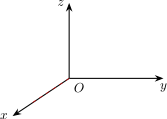
Trois demi-droites $[Ox)$, $[Oy)$ et $[Oz)$ de même origine $O$ et non coplanaires déterminent, dans cet ordre un trièdre que l'on note $(Ox; Oy; Oz)$.
$[Ox)$, $[Oy)$ et $[Oz)$ sont appelées les arêtes du trièdre $(Ox; Oy; Oz)$.
2.Bonhomme d’Ampère – Repère orienté de l’espace
Définition
Définition.
Soit $(O; \vec{i}; \vec{j}; \vec{k})$ un repère de l'espace $\mathcal{E}$. On pose : $\overrightarrow{OI} = \vec{i}$ et $\overrightarrow{OJ} = \vec{j}$ et $\overrightarrow{OK} = \vec{k}$.
Le bonhomme d'Ampère du trièdre $([OI); [OJ); [OK))$ est un personnage imaginaire porté sur l'axe $[OK)$, ses pieds sont à l'origine $O$ et regarde $[OI)$.
Le trièdre $([OI); [OJ); [OK))$ est dit direct (respectivement indirect) si le bonhomme d'ampère, traversé par le vecteur $\overrightarrow{OK}$ des pieds à la tête, regardant $\overrightarrow{OI}$ a le vecteur $\overrightarrow{OJ}$ à sa gauche (respectivement à sa droite).
Enfin, si le trièdre $([OI); [OJ); [OK))$ est direct, on dit aussi que le repère $(O; \vec{i}; \vec{j}; \vec{k})$ est direct et que la base $(\vec{i}; \vec{j}; \vec{k})$ est directe. Dans le cas contraire, la base $(\vec{i}; \vec{j}; \vec{k})$ est dite indirecte.
[Figure: Représentation du bonhomme d'Ampère pour le trièdre direct et le trièdre indirect]
On dit que le repère $(O; \vec{i}; \vec{j}; \vec{k})$ est direct lorsque le trièdre $([OI); [OJ); [OK))$ est direct.
On dit que l'espace $\mathcal{E}$ est orienté positivement lorsqu'il est muni d'un repère direct.
Proposition
Proposition.
Si le repère $(O; \vec{i}; \vec{j}; \vec{k})$ est orthonormal direct, alors :
Les repères $(O; \vec{j}; \vec{k}; \vec{i})$ et $(O; \vec{k}; \vec{i}; \vec{j})$ sont directs.
Les repères $(O; \vec{j}; \vec{i}; \vec{k})$, $(O; \vec{k}; \vec{j}; \vec{i})$ et $(O; \vec{i}; \vec{k}; \vec{j})$ sont indirects.
Les repères $(O; -\vec{i}; \vec{j}; \vec{k})$, $(O; \vec{i}; -\vec{j}; \vec{k})$ et $(O; \vec{i}; \vec{j}; -\vec{k})$ sont indirects.
Exemple
Exemple.
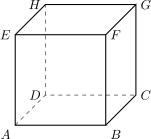
Soit $ABCDEFGH$ un cube comme le montre la figure ci-contre.
La base $(\overrightarrow{BA}; \overrightarrow{BC}; \overrightarrow{BF})$ est orthonormée indirecte.
La base $(\overrightarrow{DH}; \overrightarrow{DA}; \overrightarrow{DC})$ est orthonormée directe.
La base $(\overrightarrow{FE}; \overrightarrow{FG}; \overrightarrow{FB})$ est orthonormée directe.
Le repère $(H; \overrightarrow{HG}; \overrightarrow{HE}; \overrightarrow{HD})$ est orthonormé direct.
Remarque
Remarque.
Soit $O$ un point quelconque de l'espace $\mathcal{E}$. Alors :
\[(O; \vec{i}; \vec{j}; \vec{k}) \text{ est un repère direct} \iff \text{La base } (\vec{i}; \vec{j}; \vec{k}) \text{ est directe}\]
II.Produit vectoriel de deux vecteurs
1.Définition du produit vectoriel
Définition
Définition.
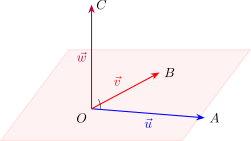
Soit $\vec{u}$ et $\vec{v}$ deux vecteurs de l'espace orienté tels que : $\vec{u} = \overrightarrow{OA}$ et $\vec{v} = \overrightarrow{OB}$.
Si $\vec{u}$ et $\vec{v}$ ne sont pas colinéaires, alors le produit vectoriel des vecteurs $\vec{u}$ et $\vec{v}$, dans cet ordre, noté $\vec{u} \wedge \vec{v}$, est le vecteur $\vec{w} = \overrightarrow{OC}$ défini par :
la droite $(OC)$ est perpendiculaire au plan $(OAB)$ ;
Si $\vec{u}$ et $\vec{v}$ sont colinéaires, alors : $\vec{u} \wedge \vec{v} = \vec{0}$.
Remarque
Remarques.
Le produit vectoriel des vecteurs $\vec{u}$ et $\vec{v}$ ne dépend pas du choix du point $O$.
Le produit vectoriel de deux vecteurs est un vecteur, tandis que le produit scalaire de deux vecteurs est un réel.
Si $\vec{w} = \vec{u} \wedge \vec{v}$, alors : $\vec{w} \perp \vec{u}$ et $\vec{w} \perp \vec{v}$ et $\|\vec{u} \wedge \vec{v}\| = \|\vec{u}\| \times \|\vec{v}\| \times \left| \sin (\overline{\vec{u};\vec{v}}) \right|$.
Si $\vec{w} = \vec{u} \wedge \vec{v}$, alors la base $(\vec{u}; \vec{v}; \vec{u} \wedge \vec{v})$ est directe. En particulier, si les vecteurs $\vec{u}$ et $\vec{v}$ sont unitaires et orthogonaux, alors $(\vec{u}; \vec{v}; \vec{u} \wedge \vec{v})$ est une base orthonormée directe.
Pour tout vecteur $\vec{u} \in \mathcal{V}_3$ : $\vec{u} \wedge \vec{u} = \vec{0}$ et $\vec{u} \wedge \vec{0} = \vec{0}$.
Les points $A$, $B$ et $C$ de l'espace $\mathcal{E}$ sont alignés si, et seulement si : $\overrightarrow{AB} \wedge \overrightarrow{AC} = \vec{0}$.
Exemple
Exemples.
Soit $\vec{u}$ et $\vec{v}$ deux vecteurs de l'espace orienté tels que : $\|\vec{u}\| = 3$ et $\|\vec{v}\| = 4$ et $(\overline{\vec{u};\vec{v}}) \equiv \frac{\pi}{6} \; [2\pi]$.
Calculons $\|\vec{u} \wedge \vec{v}\|$ :
On a : $\|\vec{u} \wedge \vec{v}\| = \|\vec{u}\| \times \|\vec{v}\| \times \left| \sin (\overline{\vec{u};\vec{v}}) \right| = 3 \times 4 \times \frac{1}{2} = 6$. Ainsi : $\|\vec{u} \wedge \vec{v}\| = 6$
Soit $\vec{u}$ et $\vec{v}$ deux vecteurs de l'espace tels que : $\|\vec{u}\| = 2$ et $\|\vec{v}\| = 5$ et $\vec{u}.\vec{v} = 5$. Calculons $\|\vec{u} \wedge \vec{v}\|$ :
Soit $\theta$ une mesure de l'angle $(\overline{\vec{u};\vec{v}})$. On a : $\cos \theta = \frac{\vec{u}.\vec{v}}{\|\vec{u}\| \times \|\vec{v}\|} = \frac{1}{2}$ et $|\sin \theta| = \sqrt{1 – \cos^2 \theta} = \frac{\sqrt{3}}{2}$.
Il s'ensuit donc : $\|\vec{u} \wedge \vec{v}\| = \|\vec{u}\| \times \|\vec{v}\| \times \left| \sin (\overline{\vec{u};\vec{v}}) \right| = 2 \times 5 \times \frac{\sqrt{3}}{2} = 5\sqrt{3}$. Ainsi : $\|\vec{u} \wedge \vec{v}\| = 5\sqrt{3}$.
Application
Applications.
Soit $\vec{u}$ et $\vec{v}$ deux vecteurs de l'espace orienté tels que : $\|\vec{u}\| = \sqrt{2}$ et $\|\vec{u} \wedge \vec{v}\| = 4$ et $(\overline{\vec{u};\vec{v}}) \equiv \frac{\pi}{4} \; [2\pi]$.
Calculer $\|\vec{v}\|$.
Soit $\vec{a}$ et $\vec{b}$ deux vecteurs de l'espace orienté tels que : $\|\vec{a}\| = 4$ et $\|\vec{b}\| = 9$ et $\vec{a}.\vec{b} = 18\sqrt{3}$.
Calculer $\|\vec{a} \wedge \vec{b}\|$.
2.Interprétation géométrique du produit vectoriel
Exemple
Exemple.
Soit $ABCD$ un parallélogramme tel que : $AB = 6$ et $AD = 4$ et $\widehat{BAD} = \frac{\pi}{6}$ rad.
En notant $\mathcal{A}$ l'aire du parallélogramme $ABCD$ (en unité d'aire), on obtient :
\[\mathcal{A} = \|\overrightarrow{AB} \wedge \overrightarrow{AD}\| = AB \times AD \times \sin \widehat{BAD} = 6 \times 4 \times \frac{1}{2} = 12\]
III.Propriétés du produit vectoriel
1.Antisymétrie du produit vectoriel
Proposition
Proposition.
Pour tous vecteurs $\vec{u}$ et $\vec{v}$ de l'espace orienté, on a : $\vec{v} \wedge \vec{u} = – \vec{u} \wedge \vec{v}$.
On dit que le produit vectoriel est antisymétrique.
2.Bilinéarité du produit vectoriel
Proposition
Proposition.
Soit $\vec{u}$, $\vec{v}$ et $\vec{w}$ trois vecteurs de l'espace orienté et $\alpha$ un nombre réel. Alors :
Soit $O$, $A$, $B$ et $C$ des points de l'espace orienté $\mathcal{E}$.
Montrons que : $\overrightarrow{AB} \wedge \overrightarrow{AC} = \overrightarrow{OA} \wedge \overrightarrow{OB} + \overrightarrow{OB} \wedge \overrightarrow{OC} + \overrightarrow{OC} \wedge \overrightarrow{OA}$
On a :
L'espace est rapporté à un repère orthonormé direct $(O; \vec{i}; \vec{j}; \vec{k})$. On pose : $\vec{u} = (2\vec{i} + 3\vec{j}) \wedge (-\vec{i} + \vec{k})$.
On a :
Par conséquent : $\vec{u} = 3\vec{i} – 2\vec{j} + 3\vec{k}$.
3.Expression analytique du produit vectoriel
Proposition
Proposition.
L'espace $\mathcal{V}_3$ est rapporté à une base orthonormée directe $(\vec{i}; \vec{j}; \vec{k})$.
Soit $\vec{u}(x;y;z)$ et $\vec{v}(x';y';z')$ deux vecteurs de l'espace $\mathcal{V}_3$. Alors :
\[\vec{u} \wedge \vec{v} = \begin{vmatrix} y & y' \\ z & z' \end{vmatrix} \vec{i} – \begin{vmatrix} x & x' \\ z & z' \end{vmatrix} \vec{j} + \begin{vmatrix} x & x' \\ y & y' \end{vmatrix} \vec{k}\]
Preuve
Preuve.
On a : $\vec{u} = x\vec{i} + y\vec{j} + z\vec{k}$ et $\vec{v} = x'\vec{i} + y'\vec{j} + z'\vec{k}$. En tenant compte du fait que $(\vec{i}; \vec{j}; \vec{k})$ est une base orthonormée directe, il en résulte de la bilinéarité du produit vectoriel :
\[\vec{u} \wedge \vec{v} = \begin{vmatrix} y & y' \\ z & z' \end{vmatrix} \vec{i} – \begin{vmatrix} x & x' \\ z & z' \end{vmatrix} \vec{j} + \begin{vmatrix} x & x' \\ y & y' \end{vmatrix} \vec{k}\]
Exemple
Exemple.
On considère les vecteurs : $\vec{u} = \vec{i} – 2\vec{j} + 3\vec{k}$ et $\vec{v} = 3\vec{i} + \vec{j} – \vec{k}$
Déterminons les coordonnées de vecteur $\vec{u} \wedge \vec{v}$ dans la base $(\vec{i}; \vec{j}; \vec{k})$ :
On a :
Par suite : $\vec{u} \wedge \vec{v} = -\vec{i} + 10\vec{j} + 7\vec{k}$
Application
Applications.
On considère les vecteurs : $\vec{u} = 2\vec{i} – \vec{j}$ ; $\vec{v} = \vec{i} – \vec{j} + 2\vec{k}$ ; $\vec{w} = \vec{j} + \vec{k}$
Déterminer, dans la base $(\vec{i}; \vec{j}; \vec{k})$, les coordonnées de chacun des vecteurs : $\vec{u} \wedge \vec{v}$ et $\vec{u} \wedge \vec{w}$.
Dans l'espace $\mathcal{E}$ rapporté à un repère orthonormé direct $(O, \vec{i}, \vec{j}, \vec{k})$, on considère les points :
\[A(1;2;3) ; B(0;-1;2) ; C(3;-2;1)\]
Calculer : $\overrightarrow{OA} \wedge \overrightarrow{BC}$ et $\overrightarrow{AB} \wedge \overrightarrow{BC}$.
IV.Applications du produit vectoriel
1.Aire d’un triangle
Proposition
Proposition.
Soit $A$, $B$ et $C$ trois points non alignés de l'espace orienté $\mathcal{E}$.
L'aire du triangle $ABC$ est :
Preuve.
Le vecteur $\vec{n} = \overrightarrow{AB} \wedge \overrightarrow{AC}$ étant normal au plan $(ABC)$ car $\vec{n} \perp \overrightarrow{AB}$ et $\vec{n} \perp \overrightarrow{AC}$. Il s'ensuit donc :
Par suite, une équation cartésienne du plan $(ABC)$ est : $(ABC) : -7(x-1) + 5(y+1) + 4z = 0$
Application
Applications.
Déterminer une équation cartésienne du plan $(ABC)$ dans chacun des cas suivants :
$1^{\text{er}}$ cas : $A(-1;2;1) ; B(-1;0;2) ; C(2;-1;0)$.
$2^{\text{nd}}$ cas : $A(1;3;5) ; B(0;0;1) ; C(1;3;5)$.
On considère les deux points : $E(3;-1;1)$ et $F(1;0;3)$.
Déterminer une équation cartésienne du plan $(OEF)$.
3.Intersection de deux plans de l’espace
Proposition
Proposition.
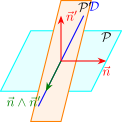
Soit $\mathcal{P}$ et $\mathcal{P}'$ deux plans sécants suivant une droite $\mathcal{D}$ dans l'espace orienté $\mathcal{E}$.
Si $\vec{n}$ est un vecteur normal de $\mathcal{P}$ et $\vec{n}'$ est un vecteur normal de $\mathcal{P}'$, alors $\vec{n} \wedge \vec{n}'$ est un vecteur directeur de la droite d'intersection $\mathcal{D}$.
Exemple
Exemple.
Déterminons l'intersection des plans : $\mathcal{P} : x – y + 2z + 1 = 0$ et $\mathcal{P}' : 2x + y – z + 2 = 0$.
On a : $\vec{n}(1;-1;2)$ et $\vec{n}'(2;1;-1)$ sont des vecteurs normaux respectivement aux plans $\mathcal{P}$ et $\mathcal{P}'$.
De plus : $\vec{u} = \vec{n} \wedge \vec{n}' = \begin{vmatrix} -1 & 1 2 & -1 \end{vmatrix} \vec{i} – \begin{vmatrix} 1 & 2 2 & -1 \end{vmatrix} \vec{j} + \begin{vmatrix} 1 & 2 -1 & 1 \end{vmatrix} \vec{k}$. Ainsi, le vecteur $\vec{u} = -\vec{i} + 5\vec{j} + 3\vec{k}$ est un vecteur directeur de la droite $\mathcal{D}$ intersection des plans $\mathcal{P}$ et $\mathcal{P}'$.
La droite $\mathcal{D}$ passe par le point $A(-1;0;0)$ (en prenant $z = 0$). Par suite :
\[\mathcal{D} : \begin{cases} x = -1 – t \\ y = 5t \\ z = 3t \end{cases} (t \in \mathbb{R}) \text{ une représentation paramétrique de la droite } \mathcal{D} \text{ intersection des plans } \mathcal{P} \text{ et } \mathcal{P}'.\]
Application
Applications.
Déterminer l'intersection des plans $\mathcal{P}$ et $\mathcal{P}'$ dans chacun des cas suivants :
$1^{\text{er}}$ cas : $\mathcal{P} : x – y + 2z + 3 = 0$ et $\mathcal{P}' : x + 2y + 2z – 1 = 0$.
$2^{\text{nd}}$ cas : $\mathcal{P} : 3x – 4y + 5z + 7 = 0$ et $\mathcal{P}' : 2x – 3y – z – 4 = 0$.
4.Distance d’un point à une droite
Proposition
Proposition.
L'espace $\mathcal{E}$ est rapporté à un repère orthonormé direct $(O, \vec{i}, \vec{j}, \vec{k})$.
Soit $\mathcal{D}$ la droite passant par $A$ et dirigée par le vecteur $\vec{u}$.
La distance d'un point $M$ de l'espace à la droite $\mathcal{D}$ est donnée par :
Preuve.
On pose : $\vec{u} = \overrightarrow{AB}$ un vecteur directeur de la droite $\mathcal{D}$.
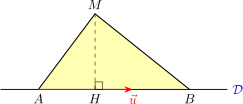
Soit $M$ un point de l'espace $\mathcal{E}$ et $H$ son projeté orthogonal sur la droite $\mathcal{D}$. L'aire du triangle $ABM$ est : $S = \frac{1}{2} \|\overrightarrow{AM} \wedge \overrightarrow{AB}\|$
et on a : $S = \frac{1}{2} AB \times MH$. Par conséquent : $AB \times MH = \|\overrightarrow{AM} \wedge \overrightarrow{AB}\|$
c'est-à-dire : $MH = \frac{\|\overrightarrow{AM} \wedge \overrightarrow{AB}\|}{AB}$. Par suite : $d(M; \mathcal{D}) = \frac{\|\overrightarrow{AM} \wedge \vec{u}\|}{\|\vec{u}\|}$
Exemple
Exemple.
Calculer la distance du point $M(-1;0;1)$ à la droite $\mathcal{D}$ définie par :
\[\mathcal{D} : \begin{cases} x = 1 + t \\ y = -1 – t \\ z = 2t \end{cases} (t \in \mathbb{R})\]
La droite $\mathcal{D}$ passe par le point $A(1;-1;0)$ et est dirigée par le vecteur $\vec{u}(2;-1;2)$.
Puisque $\overrightarrow{AM}(-2;1;1)$ et $\vec{u}(2;-1;2)$, alors : $\overrightarrow{AM} \wedge \vec{u} = \begin{vmatrix} 1 & -1 1 & 2 \end{vmatrix} \vec{i} – \begin{vmatrix} -2 & 2 1 & 2 \end{vmatrix} \vec{j} + \begin{vmatrix} -2 & 2 1 & -1 \end{vmatrix} \vec{k} = 3\vec{i} + 6\vec{j}$.
On a donc : $\|\overrightarrow{AM} \wedge \vec{u}\| = \sqrt{9 + 36} = 3\sqrt{5}$ et $\|\vec{u}\| = \sqrt{4 + 1 + 4} = 3$. Ainsi : $d(M; \mathcal{D}) = \sqrt{5}$.
Application
Applications.
Calculer la distance du point $M$ à la droite $\mathcal{D}$ dans chacun des cas suivants :
$1^{\text{er}}$ cas : $M(3;2;1)$ et $\mathcal{D} : \begin{cases} x = 1 – t y = 1 z = t \end{cases} (t \in \mathbb{R})$.
$2^{\text{nd}}$ cas : $M(3;-1;1)$ et $\mathcal{D} : \begin{cases} x – y = 1 y + z = 2 \end{cases}$.